


Hiking through Costa Rica's jungle
If you really want to experience Costa Rica’s wildlife and landscapes, you have to set off on foot. Ideally on a jungle hike.
From the car you’ll never spot a sloth in the treetops, a capuchin monkey in the beachside scrub, and certainly no hummingbird in the cloud forest.
This country’s spectacular sights are all reachable on foot – and that’s exactly what we do on our 2.5-week road trip.
Depending on the region, Costa Rica’s jungle is made up of one of four forest types:
- Tropical rainforest
- Tropical dry forest
- Cloud forest
- Mangrove forest
The most beautiful hikes are in the tropical rainforest along the Pacific coast and in the Monteverde cloud forest.
This article follows our route from south to north.

If you can only do three hikes
- Arenal 1968 Park – for the one-of-a-kind lava field meets rainforest combination
- Monteverde Continental Divide Trail – for atmosphere and biodiversity
- Lower Nauyaca Waterfalls – for the spectacular natural pool to swim in
We’ve sorted the rest of this article by our travel route.
Short on time? Scroll straight to the three highlights above: Arenal 1968 Park, Monteverde or Nauyaca.
At the outdoor hub of Uvita (southern Pacific coast)
Uvita is our base camp for three days.
From here you can reach all the highlights of the southern Pacific coast in an hour’s drive at most.

Manuel Antonio National Park
Manuel Antonio National Park: you can, but you don’t have to.
Costa Rica’s most famous national park is also its most overrun.
Getting there and arrival: At the last bend before the park, people with flags and vests wave you off the road.
We want to explore the park on our own. That’s supposedly not possible – we absolutely must take a guide, we’re told in no uncertain terms.
Intimidated, we agree to let someone climb into our rental car and direct us a few hundred meters ahead to a guarded parking lot. At least it’s right by the official entrance gate to Manuel Antonio National Park. A guide is assigned to us too, and duly charged for.
Tip: Book tickets in advance through the official SINAC platform, and the whole song and dance at the entrance falls away. If you hold your ground.
The park is closed on Tuesdays, open 7:00 to 16:00.
In the park: The trails are short and well built, often on raised wooden boardwalks. You don’t need sturdy footwear – simple sneakers will do.
There are three monkey species to marvel at, plus sloths, crabs, and the hand-sized, brilliant turquoise-blue blue morpho butterfly.
There are only a few of each, and you’ll mostly photograph through the guide’s spotting scope. He’s the only one who can spot anything in the dense jungle anyway.
Most of the capuchin monkeys hang around the white sandy beach. Well aware that anyone taking selfies is bound to have something edible in their backpack.
Never leave your backpack unattended – the monkeys are faster than you think.
Highlight: Cathedral Point, a roughly one-hour loop trail out to the forested headland.
Here you set off on your own, and there are hardly any tour groups around. Cathedral Point offers moss-covered trees, ocean views, and more monkeys than on the park’s main trails.
Beaches in the park: Playa Manuel Antonio and Playa Espadilla Sur are the real reason to visit.
Fine sand, turquoise water, rainforest right behind it. You wade into the sea, turn around, and see palms, lianas, jungle. And maybe a capuchin monkey swiping your snack from your backpack…
No need to have seen it: For me, Manuel Antonio remains a disappointment despite its fame. If you’re after solitary wilderness, you’re better off in Monteverde or other national parks.
Marino Ballena National Park
Come for the whale’s tail, stay for the whales.
The park doesn’t carry its name Ballena (whale) by chance: besides the humpback whales off the coast of Uvita, at low tide the sandbar forms a perfect whale’s tail that you can walk far out along on foot.
And when the tide comes back in, the water surges in from two sides at once. A striking natural spectacle: you have to get a move on to make it back to shore with dry feet…
Whale watching: Depending on the season, humpback whales migrate from the Arctic (December to April) or the Antarctic (July to October) into the warm bay of Uvita to give birth.
We book a tour through GetYourGuide. After a short wait, the experienced guide suddenly spots two humpback whales that keep surfacing right beside our boat.
The moment we hear them blow is magical.
Practical details:
- Park entry: approx. USD 6 to 7
- Whale-watching tour: USD 70 to 90 incl. drinking water and a watermelon snack, duration 2 to 3 hours
- Heads up: Getting into the boat, you’ll get wet up to your thighs. Choose your clothing accordingly.
Nauyaca Waterfalls - a multi-tiered spectacle
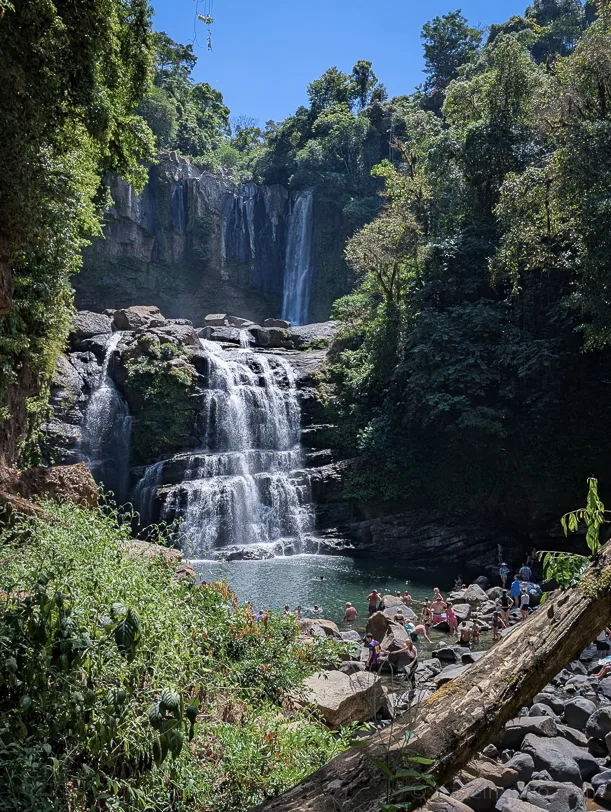
The lower Nauyaca waterfall is the star – that’s where Costa Rica’s best natural pool awaits.
Getting there: About 10 minutes north of Dominical. The last few kilometers run over a bumpy gravel road through the jungle – 4×4 highly recommended.
You can choose between two access points:
- Nauyaca Waterfall Nature Park (USD 32): gravel-road approach, fewer visitors, restaurant and restrooms on site. Our choice and recommendation.
- Don Lulo Park (USD 10 on foot): paved approach, cheaper, but more crowded.
The hike: Over 3.5 km of well-built trail, partly shaded. Which is crucial in the humid tropical heat.
The trails to the upper and lower waterfalls are well signposted.
Upper Nauyaca waterfall: In the dry season, a single powerful jet of water over a broad rock face. Impressive, but no pool to swim in.
Lower Nauyaca waterfall: A spectacular broad wall of water (even in the dry season) plunges into a large natural pool. This is where you swim after the sweaty hike. There are more visitors here than at the upper Nauyaca waterfall.
Travel tips:
- Start early because of the heat.
- Pack non-slip water shoes – the rocks around the pool are slippery.
- Use the shuttle back to the parking lot if your legs get heavy or it turns muggy-hot toward midday.
Around the little town of La Fortuna (north)
La Fortuna itself is plain and functional. Tourists come for what’s around it: Arenal Volcano, suspension bridges, waterfalls, coffee plantations. And luxury hotels.
We stay four days and still have to cut things in the end that we don’t manage to fit in.
Arenal 1968 Park - hiking across lava fields
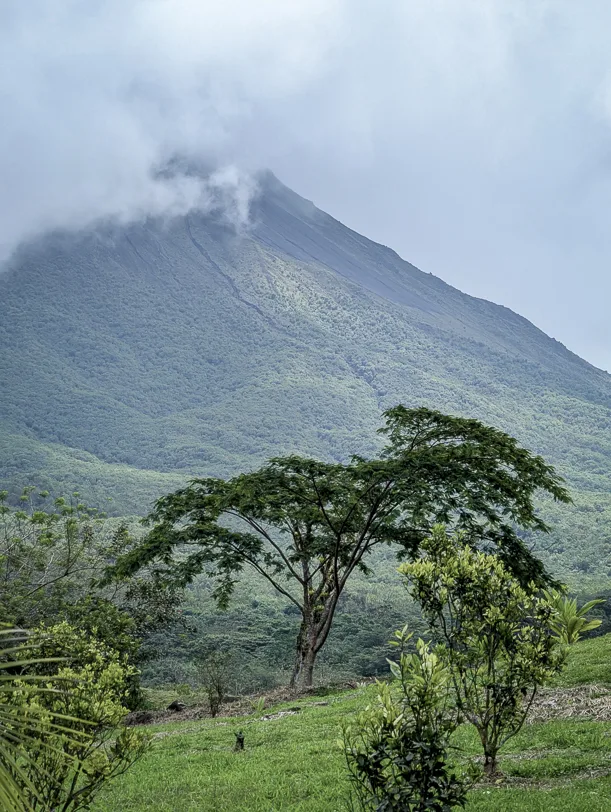
The most varied hike of the entire trip.
The park carries the date of the great 1968 volcanic eruption in its name.
The trails alternate between cooled lava fields (open, barren, surreal) and tropical rainforest (dense, shady, lush). Experience two completely different landscapes on a single hike.
Practical details:
- Entry: approx. USD 28
- Booking: arenal1968.com
- Duration: 2 to 3 hours depending on the trail you choose
- Footwear: sturdy is a must – lava is sharp-edged and uneven
- Stairs: around 500 steps up and down
The volcano itself often stays hidden in clouds. The hike is one of the most striking experiences of the whole trip regardless.
At the end, a kiosk offers refreshments with a view of the Arenal. If it shows itself, that is.
Mistico Park - suspension bridges over the treetops
You don’t walk through the forest, you float in the treetops above it.
At first, Mistico Park feels like a tourist park with a botanical garden.
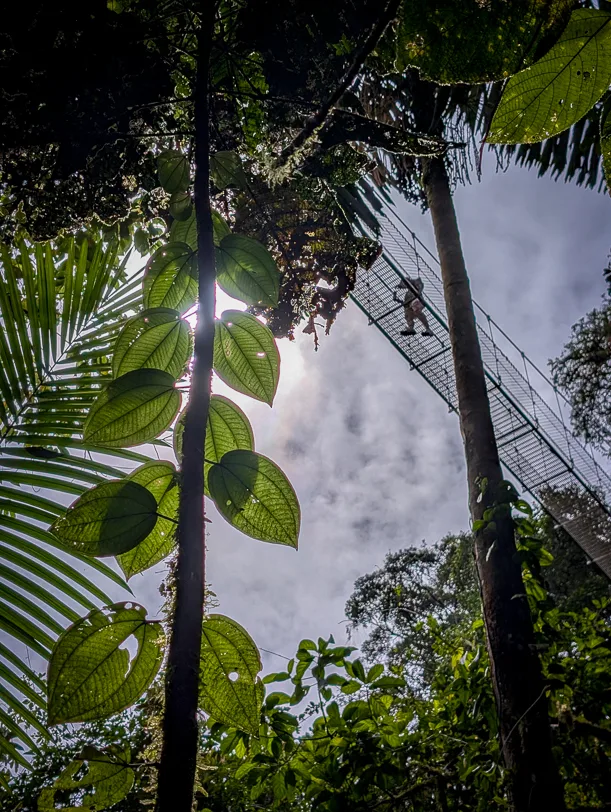
But it quickly turns into a full-blown jungle loop hike with 16 bridges, 6 of them suspension bridges. The highest measures 55 meters, the longest spans 97 meters.
The perspectives on the rainforest from above – and partly from below – are among the best in the region. Side netting helps against vertigo, but the suspension bridges sway quite a bit.
Practical details:
- Self-guided entry: USD 32
- Booking: misticopark.com
- Footwear: sturdy footwear required (checked at the entrance)
- Optional: a guide for more background on the flora and fauna
Tip: Mistico Park and Arenal 1968 are within sight of each other and combine nicely into a single day trip.
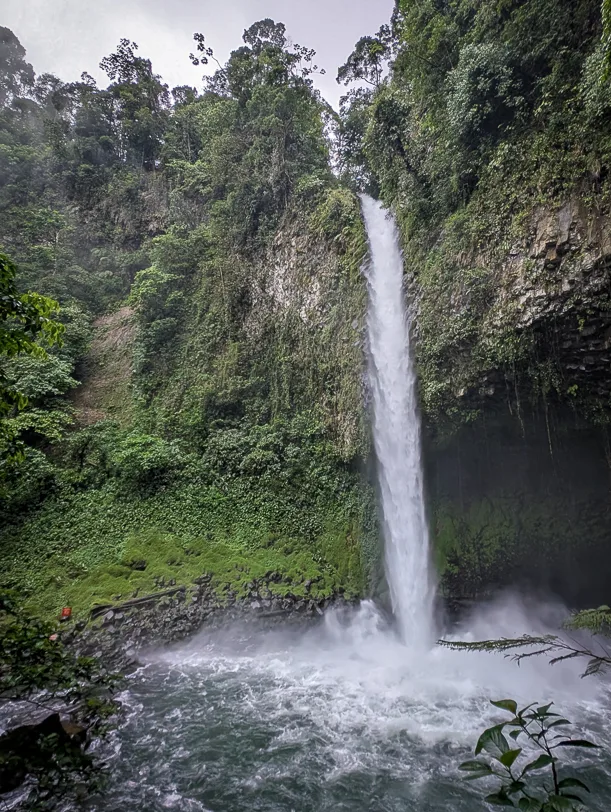
La Fortuna Waterfall
70 meters of natural spectacle that you earn with 500 steps.
The waterfall plunges 70 meters into an emerald-green pool. The descent down the stairs is steep. The climb back up all the more sweat-inducing.
If you feel like it, you can swim in the relatively cold water of a second, smaller pool behind the waterfall’s main basin.
Practical details:
- Entry: USD 20
- Booking: cataratalafortuna.com
- Footwear: non-slip shoes, plus swimwear
- Timing: early morning, fewer visitors and more active wildlife
Reward: Afterward, a cortado (espresso with a little milk foam) and an alfajor (sweet pastry with caramelized condensed milk) at the charming Vita Café across from the waterfall entrance.
Chocolate and coffee tour with Don Juan
A must in rainy weather, but worthwhile any time.
Guide Jeremy gives entertaining and informative tours on the growing and processing of chocolate and coffee.
The best part: afterward you grind and knead your own chocolate. Practice makes perfect. But no master has ever fallen from the sky: my chocolate blend doesn’t taste good…
The Arabica beans are dried and roasted here in La Fortuna, but grown in higher-elevation Monteverde.
Practical details:
- Cost: around USD 50
- Booking: GetYourGuide or directly with Don Juan
- Bonus: toucans and the occasional sloth on the plantation grounds
- Ideal: in the rain, when hiking is unappealing

Tenorio Volcano and Rio Celeste
A long drive, but the turquoise-blue river is one of a kind.
The Rio Celeste owes its name to a natural phenomenon: at a particular spot in Tenorio National Park, two mineral-rich streams mix, and the river turns a glowing turquoise blue right there.
Below it lies the waterfall of the same name, with an equally deep-blue little lake.
The hike: The trail leads past the waterfall along the river up to the staining point. Over very high steps and rough paths across rocks and roots.
Heads up: It’s not a loop, you have to come back the same way.
My planning mistake: We walk the riverside stretch first, then on to the waterfall. And end up standing in line there for an hour to see it up close.
Tip: Set off early and head straight down to the waterfall first. Only then do the hike to the Rio Celeste.
Mosquito warning: By the way, there are lots of bite-happy mosquitoes here! Don’t forget the insect repellent. In return, you’ll spot small, well-camouflaged snakes (if a guide happens to point one out).
In hilly, fresh Monteverde (highlands)
In the Monteverde highlands at around 1,500 meters, it can be a good 10 degrees cooler than on the coast.
Together with the stiff wind and frequent drizzle, it feels cooler still.
A light rain jacket belongs in your daypack, and in the evening a light down jacket does good service.
Monteverde cloud forest
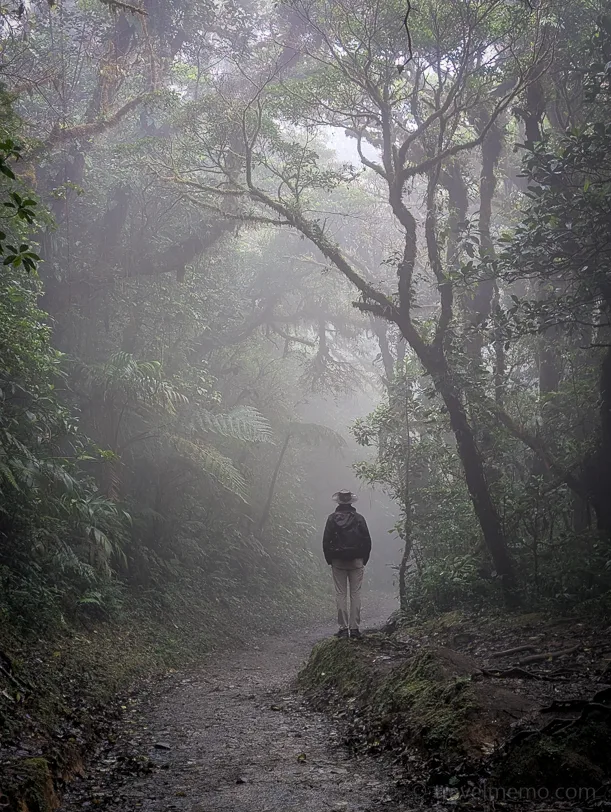
The mystical cloud forest is one of the highlights of the entire trip.
The cloud forest sits on the continental divide between North and South America. On just 26 square kilometers, over 2,500 plant species grow.
The ferns are enormous, the trees grow impressively ultra-tall into the damp sky, mostly draped in old man’s beard lichen.
Hikes: Three trail options are on offer. We pick the longest, the Continental Divide Trail, and pass through what feels like three different climate zones in two hours – cloud forest now dense, now sparse. Most of the time we’re on our own, and the trail is well signposted.
Wildlife: Hummingbirds. Without a guide, we don’t spot any other animals…
Practical details:
- Entry: USD 29
- Booking: cloudforestmonteverde.com with a time-slot system
- Required: rain jacket and sturdy shoes
- Tip: start early – in the afternoon it gets foggier and busier
Night walk near Santa Elena
With a guide you see more at night than on your own by day.
The night walk is a guided night hike of about 1.5 to 2 hours.
Your guide shines the flashlight into all the right corners. Without that trained eye you simply see nothing. At night the guide can’t see anything either, of course, but experience tells him where to point the light.
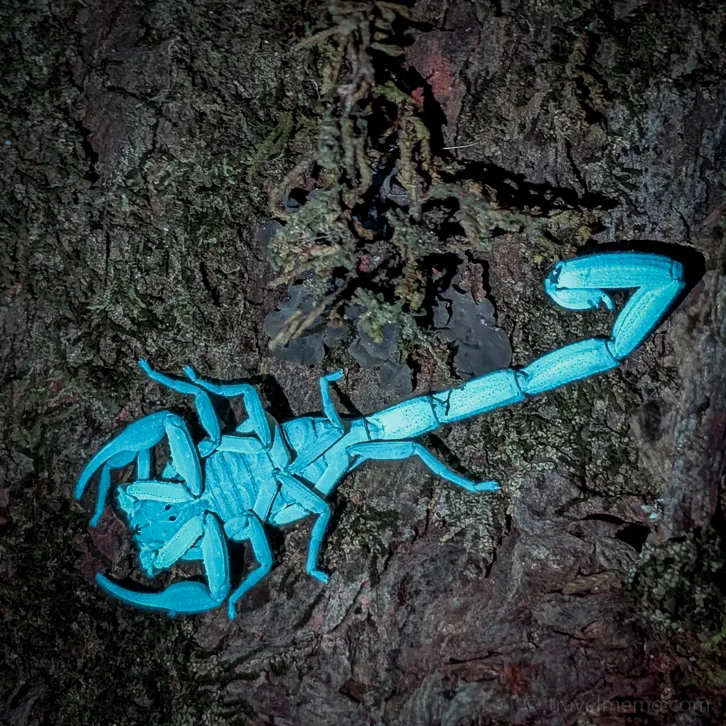
Highlight: Scorpions fluoresce a glowing turquoise under UV light. And tarantulas let their curiosity run free when you poke around with a twig in front of the right little burrow.
If you’re afraid of spiders and the dark, you’ll get over it here fast. Inevitably. Fascination wins!
Conclusion
What surprises me is how quiet the tropical rainforest of Costa Rica is, both by day and by night. Only rarely do we hear a howler monkey, an owl, or a woodpecker.
Nor is it the case that the place teems with parrots or hummingbirds. You see wildlife only sporadically.
Our favorites: I liked the mystical Monteverde cloud forest best. Katja found the loop hike across the lava fields of the Arenal the most impressive.
We both found Manuel Antonio overrated. If you’re after wilderness, head to Monteverde. If you want a beach-and-jungle combination, then Manuel Antonio really is the right call after all.
And if a gentleman in a vest approaches you there, trying to push a guide on you that you never booked: you booked online through SINAC beforehand and you don’t want a guide.
They should let you through now!
