Costa Rica is famous for its incredibly high biodiversity packed into a small country. That makes it ideal for a road trip.
You hike through tropical rainforest and dense cloud forest, drive past volcanic landscapes, spot exotic wildlife, marvel at waterfalls, and watch glorious sunsets over the Pacific.
With 30 national parks, plus countless biological reserves and private conservation areas, you’ll have a hard time choosing what to fit in.
For our 2.5-week Costa Rica road trip, we pick a route along the more tourist-developed Pacific coast. The quieter Caribbean side will have to wait for another time.
Table of Contents: Costa Rica Travel Tips
Costa Rica Road Trip at a Glance
From the capital San José’s airport, we drive south as self-drivers to Uvita on the Pacific coast, and later on to Manuel Antonio National Park.
From there, winding roads take us inland to the Arenal volcano and the mystical cloud forest of Monteverde.
We wrap up the trip on the Guanacaste peninsula in the northwest, around Tamarindo.
The return flight leaves from Liberia airport — a direct overnight flight back to Switzerland.
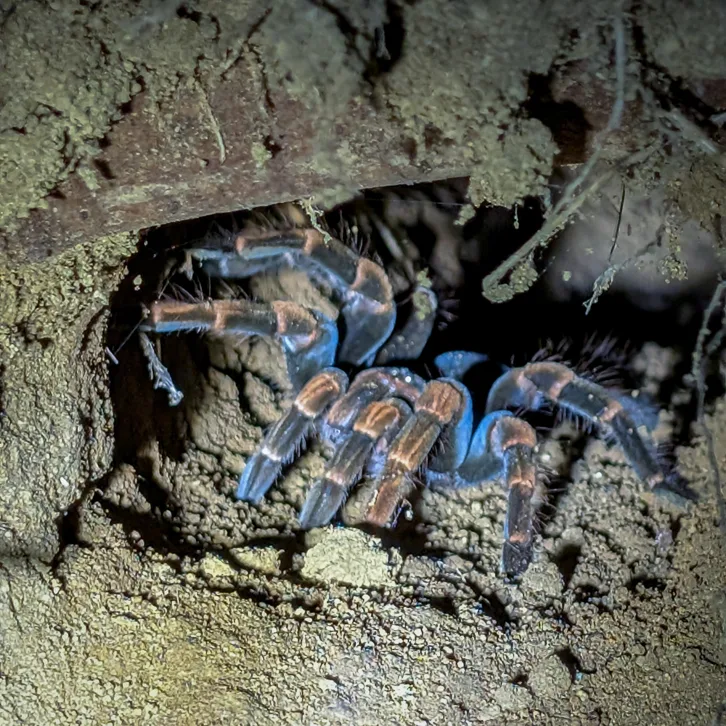
Along the way, we meet sloths and capuchin monkeys, hike across lava fields, and on a nighttime rainforest walk find ourselves face-to-face with tarantulas and fluorescent scorpions!
Oh, and depending on your jungle hotel, you’ll get an early-morning wake-up call from howler monkeys.
Costa Rica is absolutely worth the trip — but that worth has a price tag. Restaurant bills and remote boutique hotels run seriously steep.
Recommended Costa Rica Route in 6 Stops over 2.5 Weeks
Here are our travel tips along the west coast, our favorite hotels, and the most beautiful highlights and nature experiences.
The number of days per stop allows for both intense exploration and lazy days by the hotel pool.
Days 1-3: Uvita & Marino Ballena National Park
Days 4-6: Manuel Antonio National Park plus a side trip to Nauyaca Waterfall
Days 7-10: La Fortuna & Arenal Volcano
Days 11-13: Monteverde Cloud Forest
Days 14-16: Papagayo Peninsula
Days 17-18: Tamarindo & Las Baulas National Park
Highlights of the Costa Rica Road Trip
Whale watching in Uvita
Seeing humpback whales up close is one of the most memorable moments of the trip.
Arenal 1968 Park hike
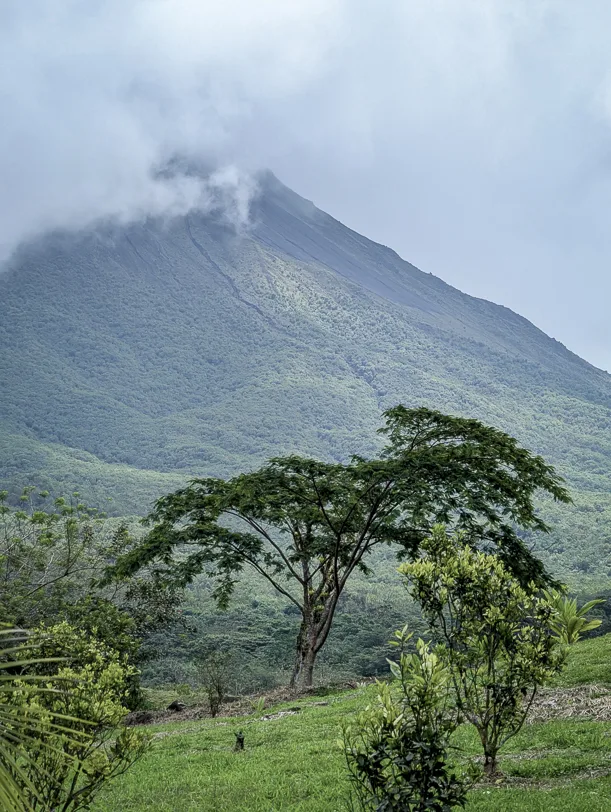
A loop trail across rough lava fields and through dense tropical rainforest. And again and again, that view of the perfectly cone-shaped Arenal volcano — when it isn’t shrouded in clouds, that is.
Monteverde Cloud Forest
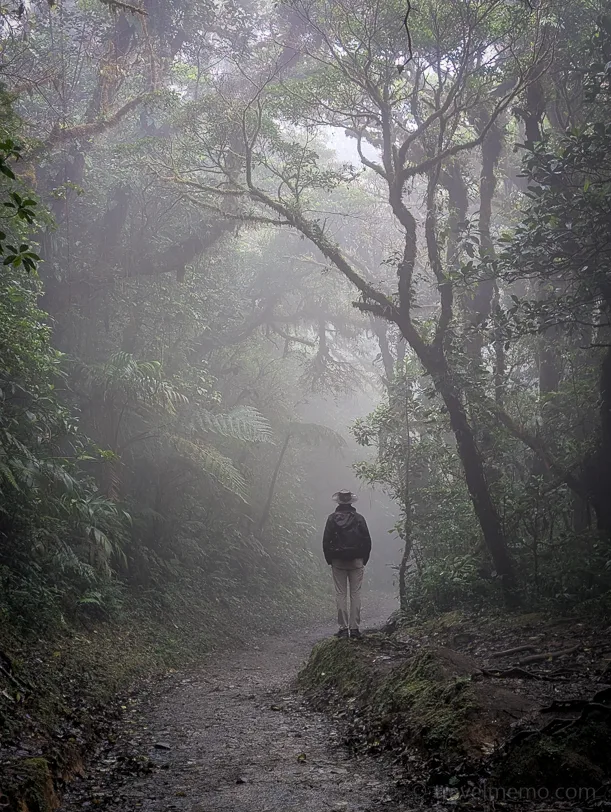
A loop hike through mystical cloud forest: moss-covered trees and ever-shifting wisps of fog. In the middle of summer.
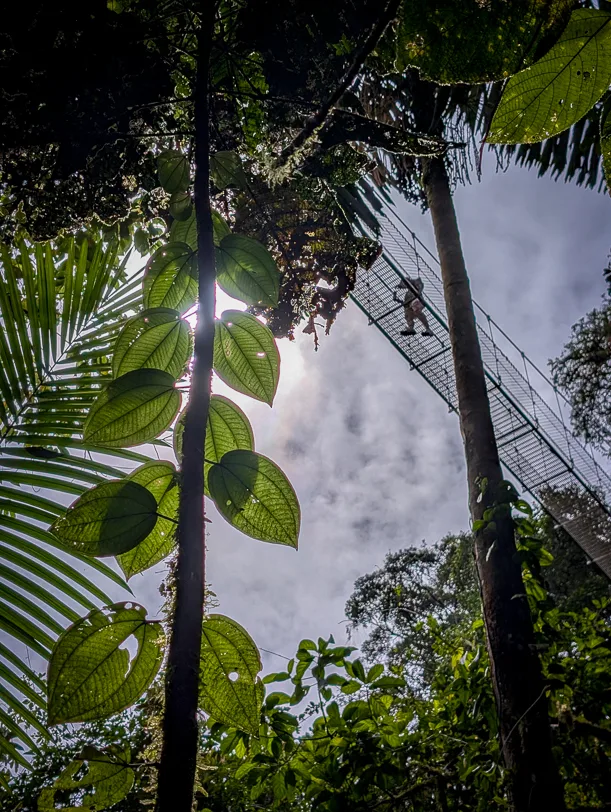
Hanging bridges in Mistico Park
A short rainforest walk with river crossings on swaying suspension bridges.
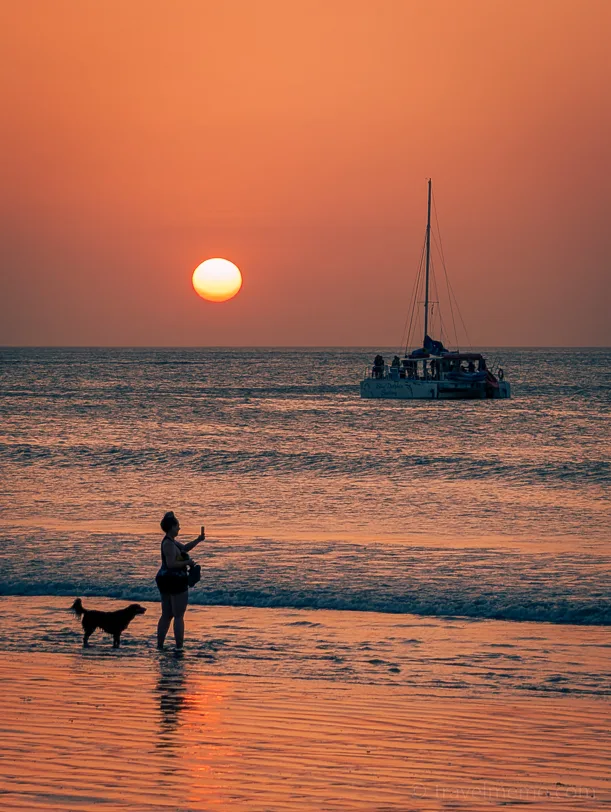
Sunsets in Tamarindo
Endless sandy beaches, surfers in the water, golden skies, and that easygoing «pura vida» mood.
Getting to Costa Rica
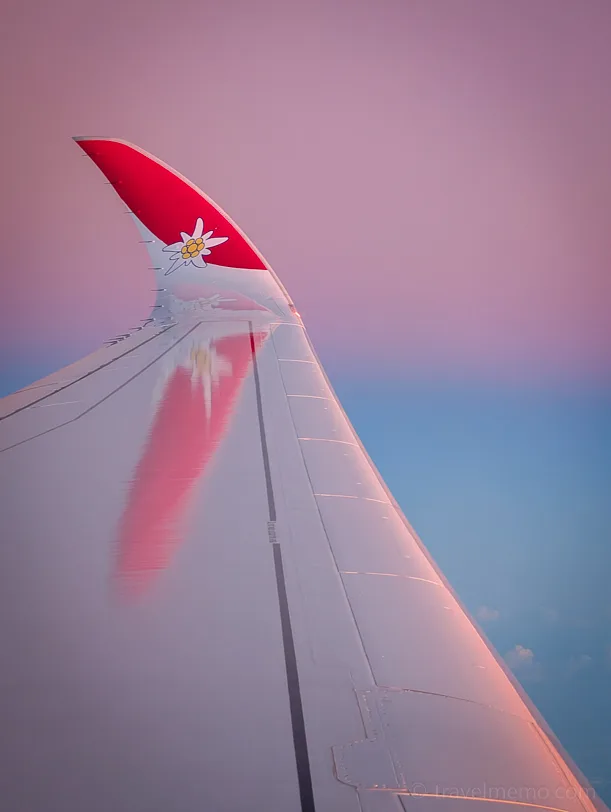
Edelweiss Air flies direct from Zurich to San José. For a road trip, though, it pays off not to fly back out of the same airport.
So we book an open-jaw ticket: in to San José, out of Liberia in Costa Rica’s northwest.
That saves us several hours of driving back to the capital at the end of the trip.
Rental car: book a 4x4 SUV — really!
One thing becomes obvious in Costa Rica very quickly: a 4WD rental car is not a luxury.
Or rather: it is a luxury, but the kind you absolutely treat yourself to.
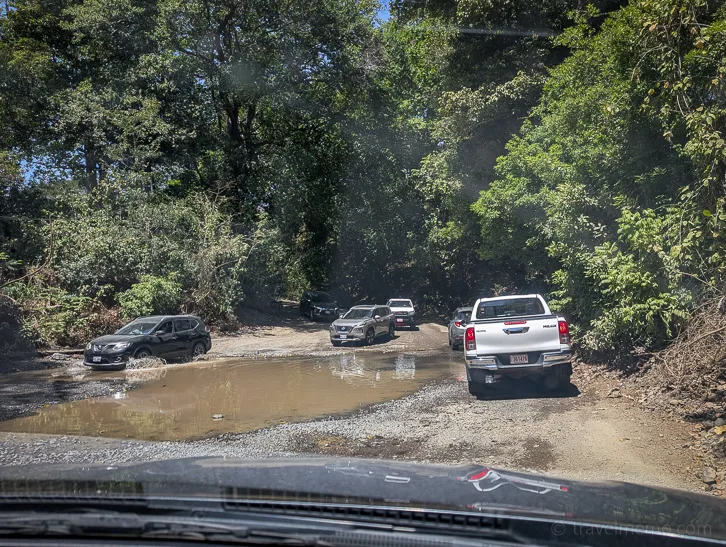
Many turnoffs from the national highways are gravel roads, pitted with potholes or steep. Sometimes ultra-steep!
The most beautiful lodges and boutique hotels tend to sit somewhere up in the forested hills, reached by an access road that has you wondering if this can really be official.
More than once we’re grateful for switchable 4WD. On some mountain roads, even our 4×4 SUV reaches its limits.
No surprise the locals favor enormous pickup trucks with serious ground clearance and chunky tires.
One tip from experience: self-drivers should schedule longer transfer days for a Sunday whenever possible.
During the week, trucks, 18-wheelers, and cars share the narrow country roads.
On Sundays, though, the locals are at the beach and the trucks are off the road — so the country roads, normally clogged, become surprisingly empty.
6 Stops for a Relaxed Costa Rica Road Trip
To get to know Costa Rica’s west coast, we recommend the following 6 stops.
Stop 1: Uvita & Marino Ballena National Park
From San José, you’re in Uvita in about 3.5 hours. You have two options: 230 kilometers, mostly hugging the Pacific along the Ruta Nacional Primera and then the Carretera Pacifica. Or the shorter 190 kilometers on the winding Carretera Interamericana.
We opt for the more relaxed, longer route. Because you quickly learn: «carretera» doesn’t always translate to «highway» — in Costa Rica it can just as easily mean a plain old gravel road…
The small town of Uvita feels pleasantly laid-back, set between green hills and the open ocean.
All the details are in this blog post.
What to do: Marino Ballena National Park
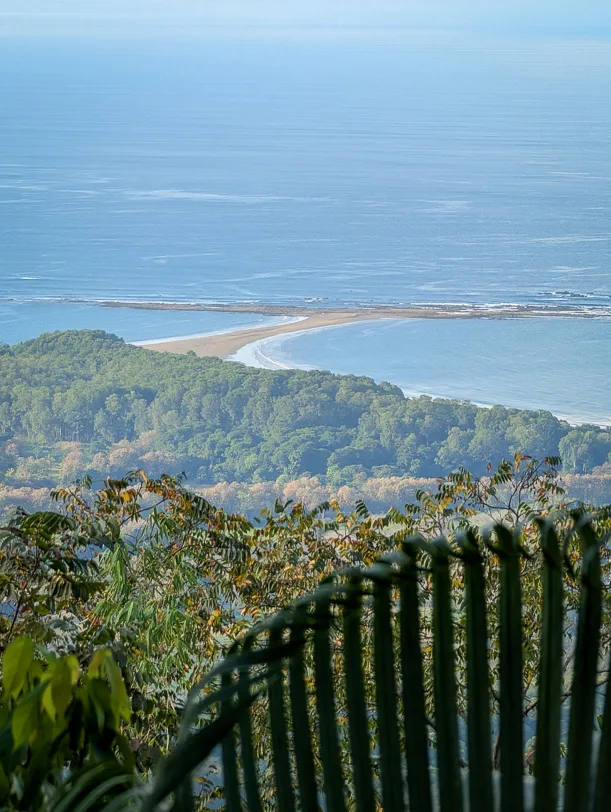
The Marino Ballena National Park is named after its famous formation: a sandbar that, at low tide, really does look like a giant whale’s tail fluke.
And the name fits for more than just the shape.
Depending on the season, humpback whales from either the Arctic or the Antarctic pass through here to give birth.
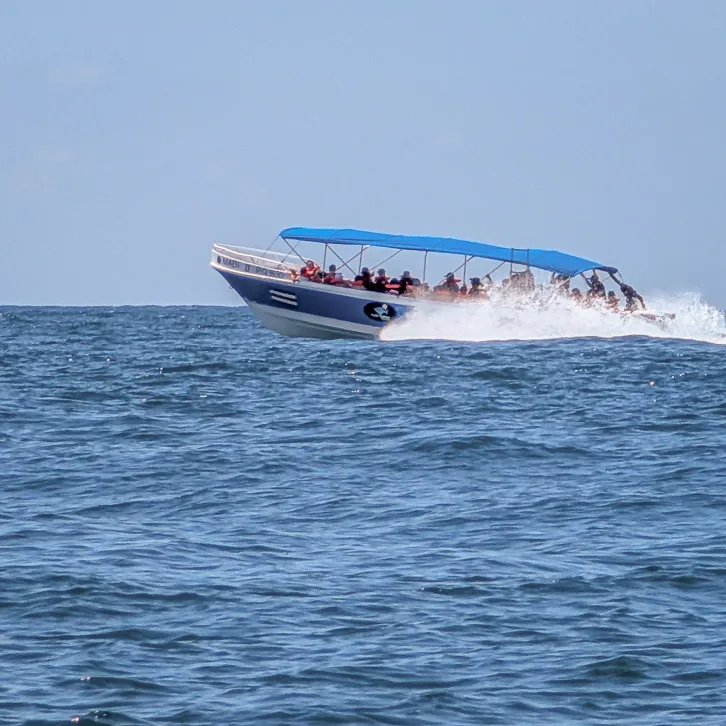
We book a whale-watching tour and actually get lucky: two whales keep surfacing right next to our boat.
Afterward, we walk barefoot along the sandbar out into the sea. That only works at low tide, though — by afternoon, the whale’s fluke vanishes completely underwater.
We even have to hurry to make it back to land with halfway-dry feet: the incoming tide hits the sandbar from both sides at once!
Hotel pick: Kurà Boutique Hotel
Our real motivation for the trip to Uvita is the hotel…
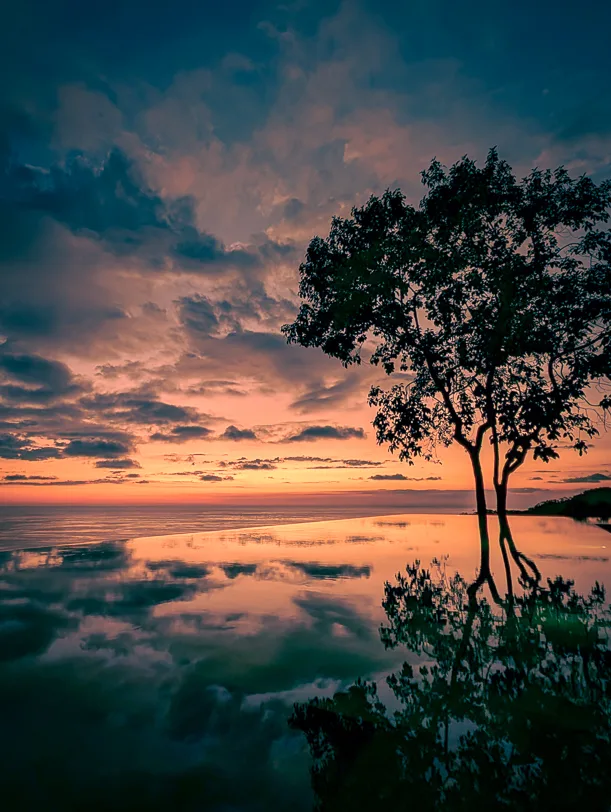
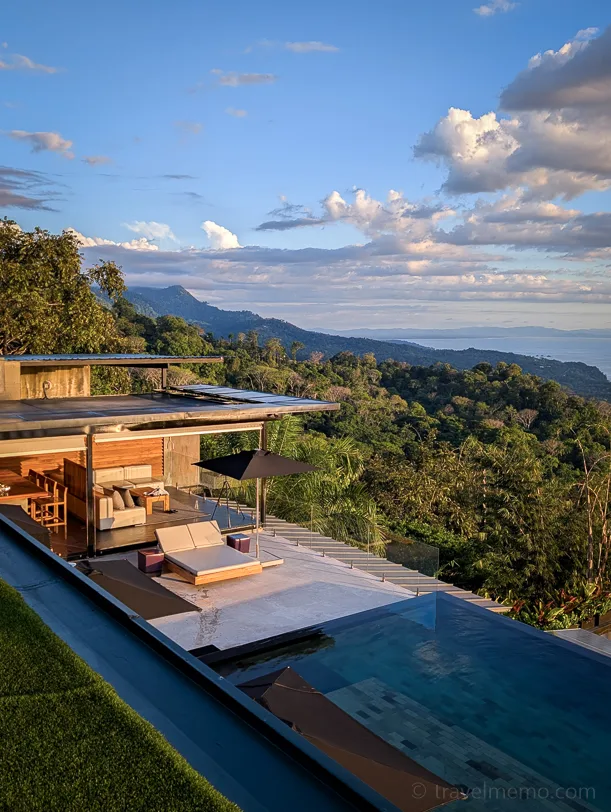
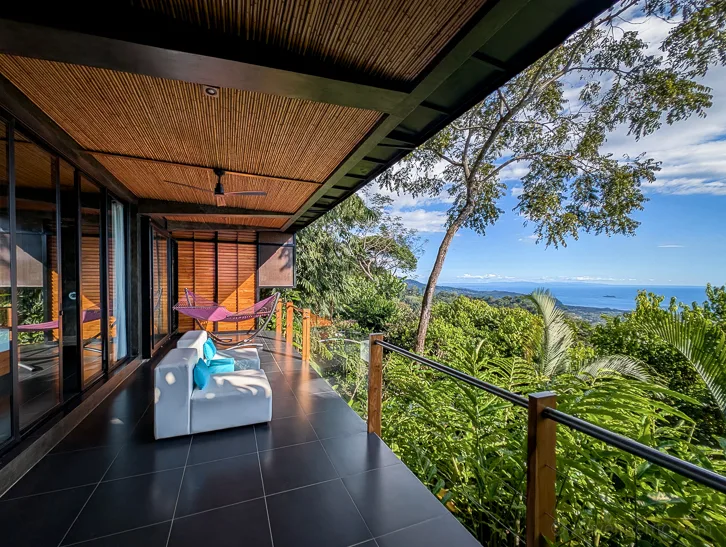
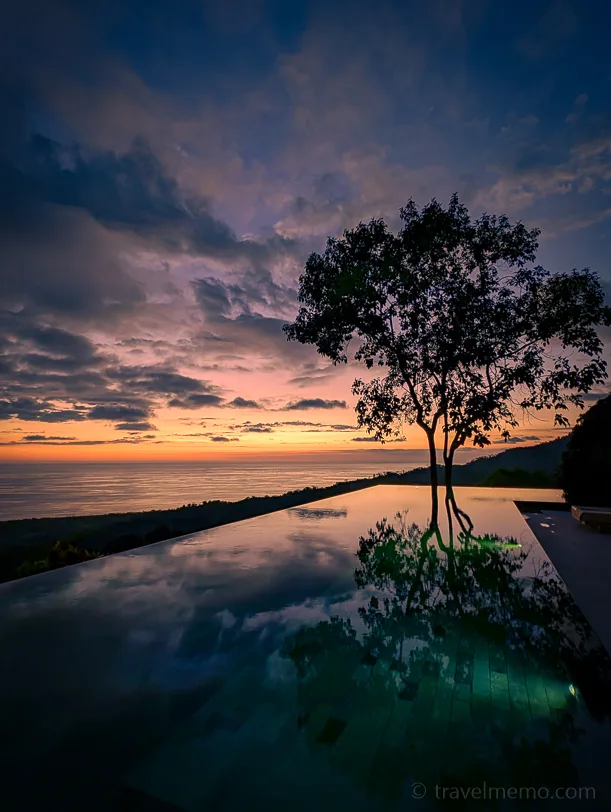
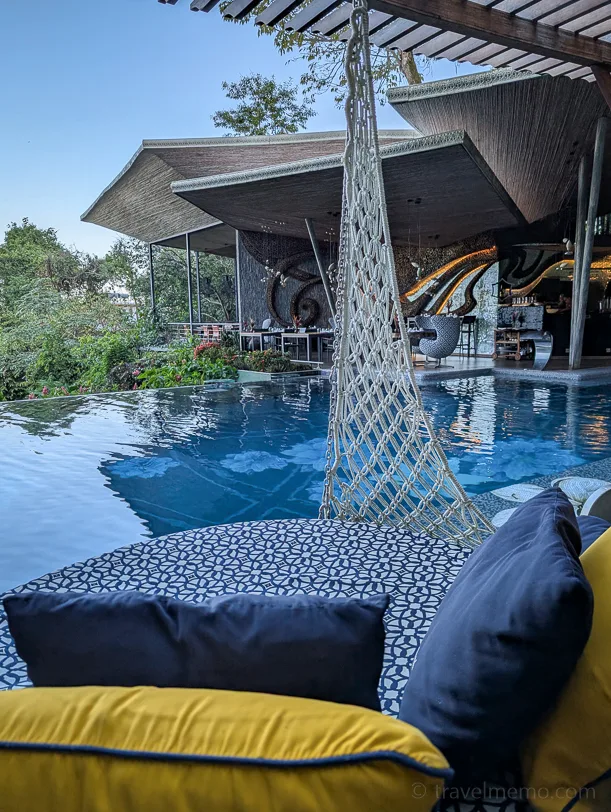
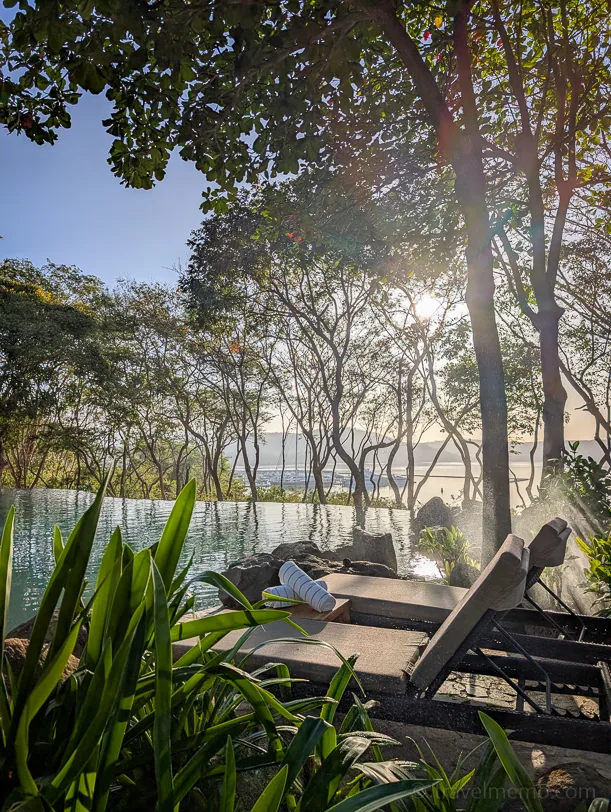
The Kurà Boutique Hotel is dreamy — to put it mildly: just eight rooms, each with a generous terrace, an airy restaurant by an infinity pool overlooking the Pacific, and impossibly friendly staff. Perfect, worry-free days in paradise!
You do have to earn the arrival, though. The access road is a piece of work: it winds steeply — very steeply — up the hillside, partly over loose stones and potholes.
On our first drive up, we have to suddenly yield in a tight AND steep hairpin to an outsized truck. What is HE doing up here?!
The lane is too narrow to pass. When Walter stops on the steep section to scout for a wider spot, our 4×4 starts skidding back down with its wheels locked!
For a moment, our eyes go wide and the pulse rate climbs notably higher than planned.
At which point you finally understand why there’s a «4×4 only!» sign every 50 meters along the road. They mean it.
After a few meters of «backward freefall», the SUV thankfully comes to a stop again.
And after a few more maneuvers and a lot of frantic hand-waving, we squeeze past the giant camion with millimeters to spare.
Afterward, Walter explains to me how this kind of thing was daily bread for him back in his Army driver days. THAT was not the impression I just got? Also, that was, what, 40 years ago, and he hasn’t owned a car since? But let’s leave it there…
The next day, we settle on the more relaxed option — with zero protest from Walter: park the car down in the village and let the hotel come pick us up.
Heads up, though: even getting to that parking lot, you’ll need a 4×4!
Day trip: Nauyaca Waterfalls
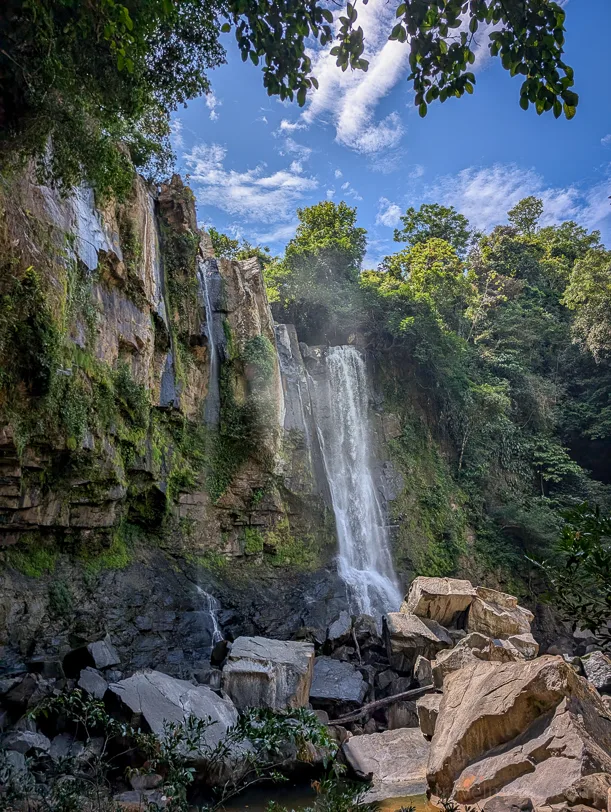
The Nauyaca Waterfalls are among the most spectacular in Costa Rica.
Even the approach is a small adventure — the last few kilometers run along a bumpy gravel track through dense jungle.
From the parking lot, you hike down through steep, thick rainforest to the upper waterfall. It’s big and powerful, but no place to swim.
The lower waterfall pours as a broad wall of water into a large natural pool. Many visitors jump straight in. After the steep hike through tropical rainforest, it feels completely refreshing.
Two access roads lead to the falls. We pick the more remote one — and sure enough, far fewer tourists.
Want to dive deeper? Here’s the full article.
Stop 2: Manuel Antonio National Park
After a few relaxed days in Uvita, you continue along the Pacific coast to Manuel Antonio National Park.
Manuel Antonio National Park
Manuel Antonio is one of Costa Rica’s best-known nature reserves — and you can tell.
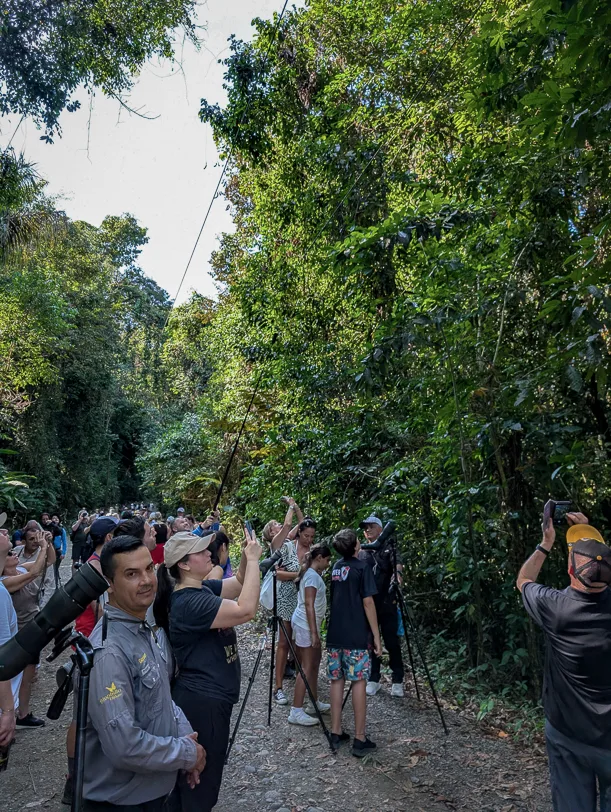
Just before the park entrance, we get intercepted on the road by guides. They tell us that without a guided tour, you can only get as far as the beach and you definitely won’t spot any wildlife.
We let ourselves be talked into it and actually book a guide, even though every blog online insists you can perfectly well explore the park on your own.
In hindsight: not a total waste. Our guide spots several animals we would have walked right past, including a sloth high up in a tree.
On the other hand: there are sooo many tourists and other guides that you can pretty much just look where everyone else is staring to find an animal.
Because, contrary to expectations, the place is not crawling with wildlife — you really do have to look hard and get lucky.
Walter ends up disappointed by the park and tells anyone who’ll listen to skip it.
I, on the other hand, thought the beach section and the loop hike out to Cathedral Point were still beautiful. These beaches are reputedly among the finest in Central America.
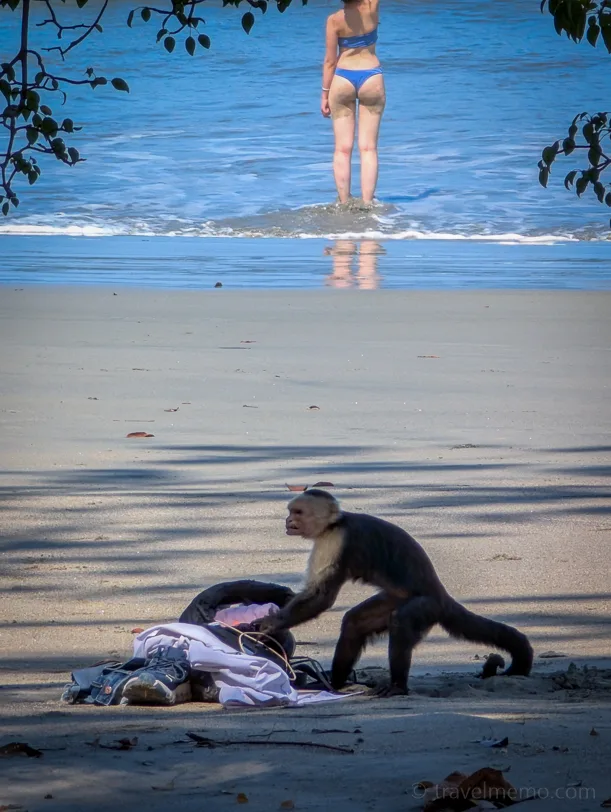
On the beach, we see more monkeys than in the entire park. Selfie-takers — be especially careful with the capuchins!
For the full report with all the details, head here.
Hotel pick: Makanda by the Sea
The design hotel Makanda by the Sea is an architecturally stylish property tucked into the jungle. Pathways and stairs link the buildings, with tropical vegetation running wild on all sides.
One small catch about the location: the hotel sits on a shaded slope, so the sun doesn’t reach the pool area until midday.
Our verdict: anyone who values design, quiet, and a great pool will be happy here.
Anyone primarily after a beach vacation should look elsewhere. As the name “Makanda by the Sea” suggests, the hotel does have its own sandy beach, but the path down is long and very steep. The upside: if you’d rather not walk, the staff will shuttle you back and forth in an off-road 4×4 golf cart.
Stop 3: La Fortuna & Arenal Volcano
After a few days by the sea, we say goodbye to the Pacific coast — for now.
The closer you get to La Fortuna, the more often the perfectly shaped Arenal volcano shows up on the horizon.
What to do: Four experiences you shouldn't miss
One of the most beautiful hikes of the trip is in Arenal 1968 Park.
The trail leads across cooled lava fields and through tropical rainforest.
Every now and then the view to the volcano opens up. Well — when it isn’t wrapping itself in clouds, anyway.
And volcano aside, the area around La Fortuna has plenty to offer.
More on that in our full blog article.
Hotel pick: Nayara Gardens
The Nayara Gardens grounds feel more like a botanical garden than a hotel.
Small paths wind between tropical plants to pools, restaurants, and private bungalows.
Water trickles somewhere at every turn, and the soundtrack is birds and frogs.
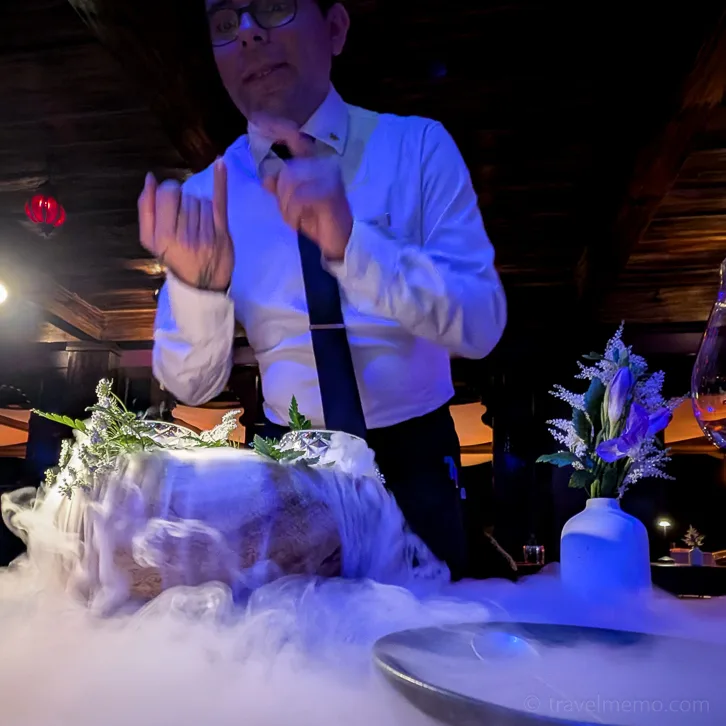
We treat ourselves to a multi-course tasting menu at the hotel restaurant Amor Loco — an evening we’ll be talking about for a long time…
Stop 4: Santa Elena in the Monteverde Highlands
From La Fortuna, the route takes you on into Santa Elena, the outdoor mecca up in the Monteverde highlands.
The road there gets narrower and narrower, asphalt gives way to gravel more and more often, and at some point the first wisps of fog start drifting between the trees.
https://maps.app.goo.gl/4ciGsGqq39tumbVs5What to do: Monteverde Cloud Forest Reserve
The Monteverde Cloud Forest is one of Costa Rica’s most fascinating ecosystems.
The reserve is world-famous for its sheer biodiversity.
Moss-covered trees, dense vegetation, darting hummingbirds, and ever-shifting fog give the forest a singular, magical atmosphere.
For us, Monteverde is one of the highlights of the entire trip! Why? We’ve gathered all our impressions in this blog post.
What to do: Night Walk
The Night Walk wasn’t originally part of the plan.
Honestly, I was a little skeptical. Looking for crawling critters — at night, no less! — does not exactly rank among my favorite activities.
In the end, we book the tour anyway.
And as it turns out, this stroll becomes one of the most memorable experiences of the entire trip!
Hotel pick: Koora Hotel Monteverde
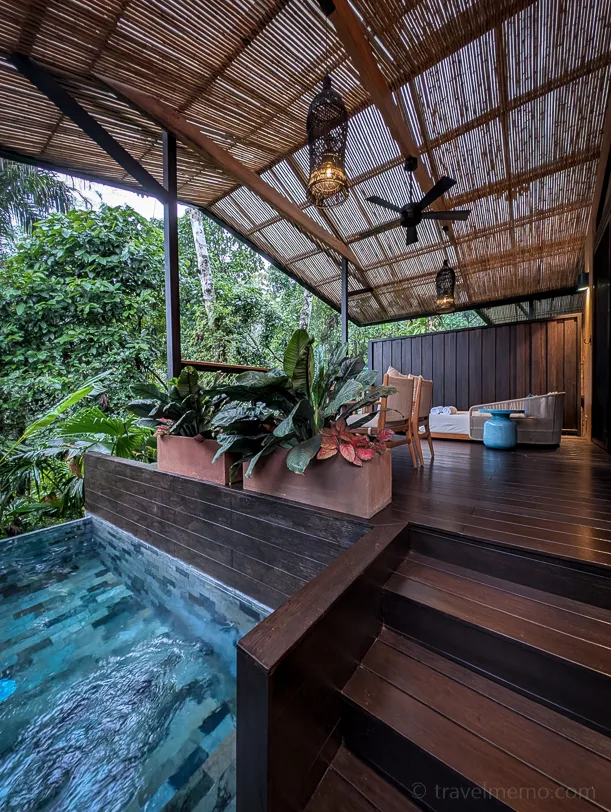
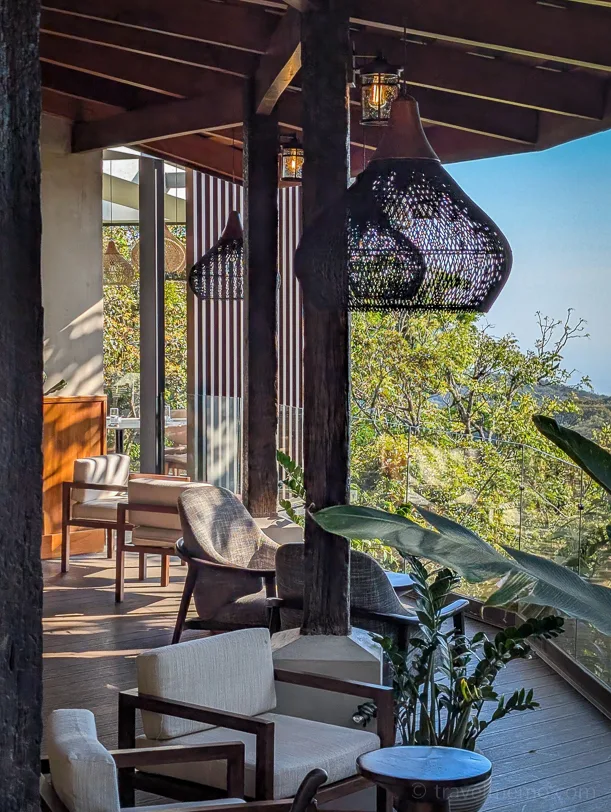
High above Santa Elena, the elegant bungalows of the stylish Koora Hotel tuck themselves into the rainforest.
Similar hotels in the same area:
Stop 5: Papagayo Peninsula
From the cool cloud forests of Monteverde, you head back down toward the Pacific — out to the Papagayo Peninsula.
The Papagayo Peninsula in the northwest of Costa Rica feels a little like a quiet counterpoint to the rest of the country.
After days of dense rainforest and bumpy roads, suddenly everything opens up: wide, dry, easy. Gentle hills replace jungle, the sea shimmers turquoise, and the coves feel almost secluded.
This region is known for its gorgeous beaches, luxurious resorts, and picture-perfect sunsets.
And yet the classic Costa Rica feeling stays intact — especially at night, when howler monkeys move through the trees and remind you that you’re still right in the middle of nature.
Hotel pick: Andaz Papagayo
The Andaz Papagayo sits right on the ocean — a classic resort with several pools and plenty of space to unwind.
Only the howler monkeys, at night and early in the morning, remind us that we’re still right in the middle of nature.
If you’ve never heard a howler monkey’s call: it sounds less like a monkey and more like a jet engine on final approach!
Stop 6: Tamarindo
To wrap up the trip, we drive to the coastal town of Tamarindo.
The place is lively, touristy, and especially popular with surfers. In the evening, crowds gather on the beach to watch the sunset.
After the quiet of the Papagayo Peninsula, Tamarindo feels almost like a small surf metropolis. But that’s exactly what gives this last stop its charm.
If you want more pura vida: here’s our full report.
And from Tamarindo, it’s only another 1.5 hours to Liberia airport.
https://maps.app.goo.gl/aoimExJtt3CG5xd39
Good to know for your Costa Rica trip
Entry, language and currency
For entry, you need a passport that’s still valid for 6 months after arrival.
The national language in Costa Rica is Spanish. You’ll do just fine with English, though.
The local currency is the Costa Rican Colon (CRC), but US dollars are accepted in many tourist areas.
Best time to visit
Costa Rica has a tropical climate year-round, so any time of year works.
The high season (December – April) brings reliably sunny days. The green season (May – November) sees more rain, but rewards you with stunning natural phenomena. Temperatures vary by region and elevation.
Plan for a 4×4 rental
Many lodges sit on unpaved, sometimes very steep dirt roads. Outside of San José, almost everyone drives a 4×4 SUV.
Book national parks early
Popular parks like Manuel Antonio cap daily visitor numbers. You can book tickets online in advance.
Don’t underestimate drive times
Twisty country roads, trucks, and traffic jams can stretch your travel time. The country has toll highways, but very few of them in total.
Gas stations are plentiful. We fill up three times for a combined CHF 150 (roughly $170).
Traffic conditions are no problem for self-drivers.
Mind the price level
Costa Rica is among the most expensive countries in Central America. On top of generally high prices, you add 13% VAT and 10% tips.
So on top of already steep restaurant prices for food and drinks, almost a quarter is added in extra charges.
If the service was great, you round the tip up a little.
Our verdict on the Costa Rica road trip
What surprised us most about Costa Rica was the sheer variety of landscapes and vegetation: within just a few hours, you go from Pacific beaches to volcanic terrain, or from tropical rainforest into a mystical cloud forest.
That mix of biodiversity is exactly what makes traveling Costa Rica so special.
Wishing you a safe road trip — pura vida!
If you have more time on your hands: there’s also the Caribbean coast on the Atlantic side. Word is it’s much less developed for tourism.